
Kids credit card in 2026: What they really are and what your child actually needs

- 💳 Credit cards for kids don’t exist, what parents are actually looking for are safe, supervised spending tools.
- ⚖️ Debit-based solutions are better for kids because they eliminate debt risk and reinforce real money habits.
- 🧠 The best tools combine parental controls, chores, and rewards to teach kids how to manage money early.
Quick answer
There is no such thing as a credit card for kids in 2026. U.S. law requires cardholders to be at least 18 years old. What parents searching for a “kids credit card” actually need is a debit-based alternative with parental controls, spending limits, and financial learning tools. Modak is the best free option: no monthly fees, no debt risk, chore-based earnings, and built-in rewards that teach kids to manage money from an early age.
Every month, thousands of parents search for terms like “kids credit card,” “free credit card for kids,” or “credit cards for kids under 18.” The intent is clear: they want a safe, structured way for their child to learn how to handle money in the real world.
But there is a fundamental misunderstanding built into these searches. Real credit cards for minors do not exist in the United States and for good reason. What most parents are actually looking for is something quite different: a supervised spending tool with educational features, parental controls, and no risk of debt.
This guide explains what “kids credit cards” really are, why credit is not appropriate for minors, what the safe alternatives look like, and how to choose the right one for your family in 2026.
Can a child under 18 get a credit card in the U.S.?
No. Under the Credit Card Accountability Responsibility and Disclosure (CARD) Act of 2009, individuals must be at least 18 years old to obtain a credit card in their own name. For applicants under 21, the law also requires proof of independent income or a co-signer.
This means that no matter how many products are marketed as “kids credit cards,” none of them are actual credit cards issued to a minor. A minor cannot legally enter into a credit contract, does not have a credit history, and is not protected by standard consumer credit laws in the same way adults are.
The products that appear when parents search for kids credit cards fall into one of two categories:
- Prepaid debit cards marketed with credit-card-adjacent language
- Adult credit cards that allow minors to be added as authorized users
Neither of these is a credit card issued to a child. Understanding this distinction is the most important step in choosing the right tool for your family.
Why credit cards for minors don’t exist (and shouldn’t)
Even if credit cards for minors were legal, there are strong reasons why financial educators and child development specialists recommend against giving children access to revolving credit.
Debt risk
A credit card allows the holder to spend money they do not have. For a child who is still learning the basics of money management, this fundamentally distorts the relationship between earning, spending, and saving. Children who grow up associating spending with credit — rather than with money they have earned — are more likely to carry debt into adulthood.
Interest and fees
Credit cards charge interest on unpaid balances and late payment fees. These mechanics are abstract and difficult for children to understand. A child who overspends on a credit card does not experience the immediate consequence of an empty balance they experience a confusing bill weeks later. Debit-based tools, where the card simply stops working when the balance runs out, provide a much clearer and more immediate financial lesson.
No legal protection for minors
Minors cannot legally be held responsible for credit card debt in their own name, which is one reason credit card issuers do not issue cards to them directly. If a child is added as an authorized user on a parent’s card, any charges made by the child are legally the parent’s responsibility with no independent limit or control mechanism for the child’s portion of spending.
Can I add my child as an authorized user on my credit card?
Yes, most major credit card issuers allow account holders to add children as authorized users on their account. The child receives a card linked to the parent’s credit line and can make purchases. Some issuers allow authorized users as young as 13; others have no minimum age requirement.

However, this approach has significant limitations as a tool for teaching financial responsibility:
Pros of adding a child as authorized user
- The child begins building a credit history early (if the issuer reports to credit bureaus for authorized users)
- No separate account to manage the child’s card is linked to the parent’s account
- Useful for older teenagers approaching 18 who want to begin establishing credit
Cons of adding a child as authorized user
- The parent is fully liable for all charges there is no separate spending limit for the child’s card
- Most credit cards offer no parental control features for authorized user sub-accounts
- No chore integration, no savings goals, no educational features
- If the child overspends, it affects the parent’s credit utilization ratio
- No dedicated app or interface designed for a child’s experience
- Does not teach the connection between earning, saving, and spending
For parents of young children (under 16), adding a child as an authorized user is generally not the most effective financial education tool. Purpose-built debit platforms like Modak provide a far more structured and educational experience with zero risk to the parent’s credit.
For teenagers approaching 18 who want to start building credit history, adding them as an authorized user on a low-limit card can be a reasonable transitional step but it works best when the teen already has a foundation of financial habits built through a platform like Modak.
How Modak helps
- 🚀 Modak provides a debit-based alternative with no fees and zero risk of debt for kids.
- 🎮 Kids earn real money through chores, steps, and challenges with MBX rewards.
- 👨👩👧 Parents get full control and visibility while kids build strong financial habits safely.
What parents searching for a kids credit card actually need
When parents search for “kids credit card free” or “credit card for kids chores,” they are not actually looking for credit products. They are looking for a combination of specific features that help their child develop healthy money habits:
- A card their child can use independently for everyday purchases
- The ability to link spending to chores and allowance (a “credit card for kids chores” experience)
- Parental visibility and control over every transaction
- No fees, no debt, and no risk of overdraft
- Educational tools that make money management engaging for kids
- A platform designed specifically for children not an adult product adapted for a younger user
None of these requirements involve credit. They are all features of well-designed debit platforms. The term “kids credit card” has become a colloquial way of describing a supervised spending tool, even though the product parents are describing is entirely debit-based.
Kids credit card vs. kids debit card: What is the actual difference?
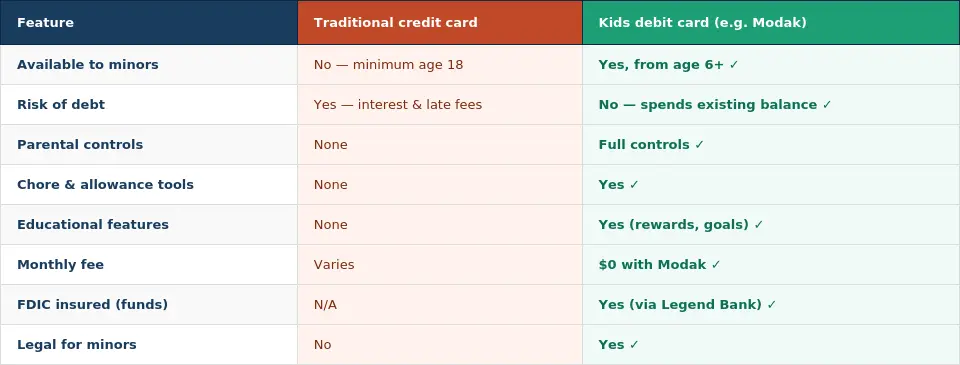
The table below compares what parents imagine when they search for a “kids credit card” against what a purpose-built kids debit card like Modak actually offers.
The conclusion is clear: what parents want when they search for a kids credit card is precisely what a purpose-built kids debit card provides, and without any of the risks that make credit cards inappropriate for children.
What is the best free alternative to a credit card for kids in 2026?
The best free alternative to a credit card for kids in 2026 is Modak. It is the only platform in this comparison that combines zero monthly fees with a full suite of financial education tools, gamified rewards, chore management, and robust parental controls.
Other platforms like Greenlight and BusyKid offer strong feature sets but require monthly subscriptions. Chase First Banking is free but requires a Chase parent account and offers no educational or reward features. Current is fee-free but primarily designed for teenagers and lacks parental oversight tools suitable for younger children.
Modak: Best free kids credit card alternative
Cost: $0/month, no monthly fee, no hidden fees for standard use
Modak is a financial technology company built specifically for kids and teens in the U.S. It provides a Visa debit card issued by Legend Bank, N.A. — FDIC-insured — along with a dedicated app for both parents and children.
Modak delivers everything parents are looking for when they search for a kids credit card: supervised spending, chore-based earning, savings goals, and full parental control, without any of the risks associated with credit.
What Modak includes:
- No monthly fee, no subscription, no minimum deposit
- Chore and allowance management built into the parent app
- Full parental controls: instant card lock, spending limits, real-time alerts
- Savings Goals to teach long-term financial planning
- Physical and virtual Visa® debit card
- Apple Pay and Google Pay compatible
- 24/7 customer support
- Sign up for free.
FAQs
Is there a credit card for kids?
No, minors can’t legally get their own credit cards.
But tools like Modak provide supervised spending and learning opportunities with built-in parental controls.
Can I get my 9 year old a bank card?
Yes, platforms like Modak are designed for children and teens, supporting users from early childhood through age 17.
They’re safer than traditional bank accounts and come with parental controls built in.
What card can a 12 year old get?
A 12-year-old can use a supervised debit-based tool.
Apps like Modak are the safer and more educational route.
What is the youngest age to get a credit card?
Legally, you must be 18 years old to get a credit card in your own name.
Minors can be added as authorized users, but that comes with risk and lacks built-in controls.
The bottom line: What your child actually needs instead of a credit card
You want your child to learn how to manage money. A “kids credit card” sounds like a smart step. But what you really want is safe independence: a way for them to spend, save, and learn, with your guidance.
That’s where Modak shines. It’s not a credit card, and that’s the point. It gives you everything you hoped a kids credit card would offer: no fees³, no debt, full visibility, chore-based earnings, and hands-on financial education.
If your child is ready to manage money, Modak offers the perfect first card. A free kids credit card alternative, with zero risk and real-world benefits.
Try Modak today and explore the safest, smartest alternative to credit cards for kids.